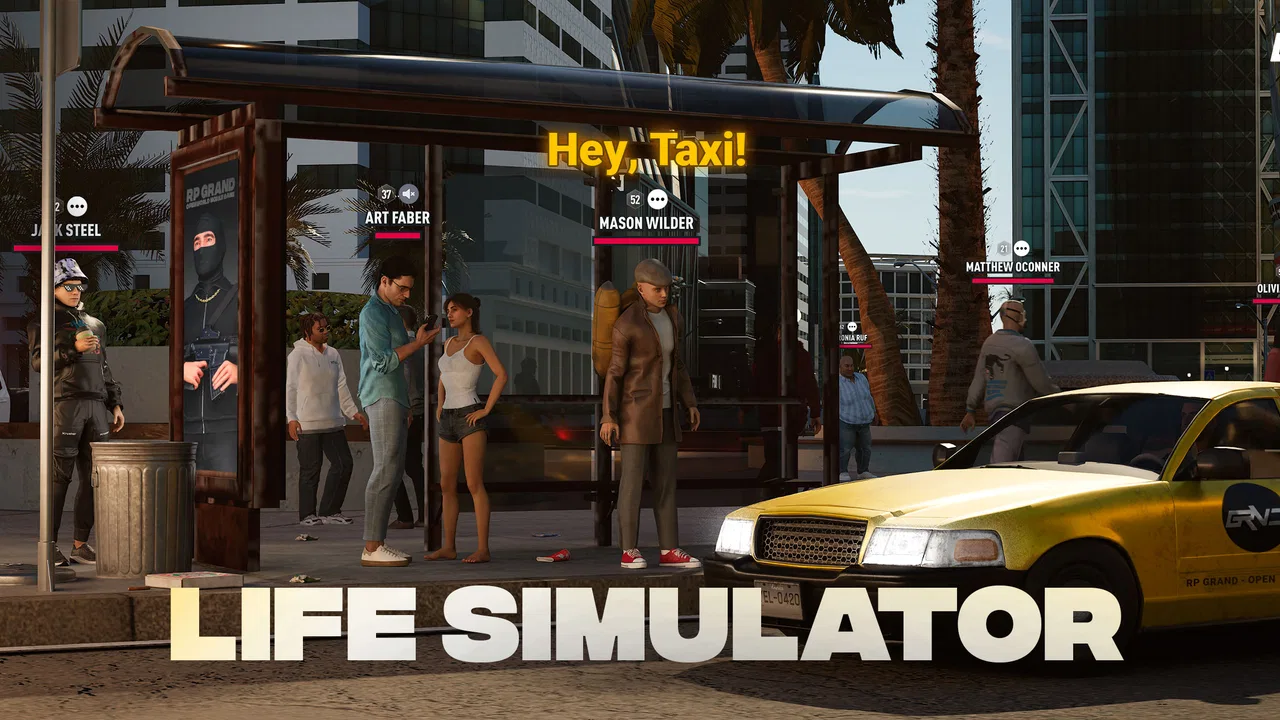
RP Grand - Open World Game
- 4.5
- Rating
- 10.00M
- Installs
- Free
- Price

 Analysis by App-foxy
I first approached RP Grand expecting a familiar mobile crime sandbox: get into a car, cause trouble, avoid the police, and repeat. That basic impression is accurate, but it misses the part that makes this role-playing game worth trying. The real appeal is the way a small decision quickly turns into a situation. I can begin with a simple drive, cross paths with other players, join a gang-related activity, or attract police attention, and suddenly the session has a direction.
This is an open-world action game from Grand Games AV, built around cars, gangs, police, and online roleplay with real players. It is free to start, although optional purchases range from $0.49 to $99.99 per item. The game is rated Teen, so I would not treat it as a children’s driving game. Its category is role-playing, but it plays more like a multiplayer action sandbox than a dialogue-heavy adventure.
After spending time with it, my honest view is that the strongest reason to return is not a single mission or collectible. It is the changing rhythm of each session: act, see an immediate reaction, gain something from the outcome, lose momentum or get interrupted, then decide whether the next attempt might go better. That loop is simple, sometimes messy, and surprisingly effective when other players are active.
You May Also Like

 Pandora - Music & Podcasts
Pandora’s Music Is Easy to Start, but Harder to Recover
Pandora’s strength is its low-effort path from a seed to a station. Its weak spot is how much confidence it asks you to place in connection, setup, and quiet recovery.

 8 Ball Pool
 Is Built on Rivalries, Rematches, and Routine
A close look at the rivalries, rematches, shared routines, and unanswered safety questions that turn a quick pool match into a persistent mobile community.

 Samsung Music
’s Quiet Strength Is Playing What You Already Own
Its reach comes less from spectacle than from dependable access to a personal library. That simplicity is both the app’s strongest retention engine and its ceiling.

 AccuWeather: Weather Radar
AccuWeather Review: A Quick, Clear Forecast for Everyday Decisions
For everyday plans, the best forecast is the one you can understand quickly. AccuWeather makes rain timing, radar, and local conditions easy to act on, with a few trade-offs.

 Hill Climb Racing
Why Hill Climb Racing Still Turns Crashes Into One More Run
A tiny car, a bumpy hill and one more upgrade: Hill Climb Racing keeps resurfacing because its simple chaos makes every near-miss feel personal.

 AliExpress - Shopping App
AliExpress Makes Global Shopping Feel Personal, but Shoppers Bear the Risk
AliExpress turns a global marketplace into a pocket-sized discovery engine. Its reach is useful, its shopping loop compelling, and its trade-offs easy to miss.
More From Our News Desk
View All News


How the first action sets the tone
I find that the opening move matters because it gives an otherwise open session a clear personal aim: observe, explore, or seek trouble. Choosing that intention before driving helps me judge which encounters are worth approaching and which are better left alone. That small bit of self-direction sets up the game’s more immediate cycle of action and consequence.
Starting with movement instead of menus
The first useful thing to understand is that RP Grand wants me in the world quickly. Cars are not just decoration; they are the easiest way to feel the scale of the setting and to move from one situation to another. Driving gives the game its first layer of freedom. I can choose a route, look for activity, and decide whether I want a quiet start or a more aggressive one.
That freedom also means the game does not always tell me exactly what kind of player I should be. Someone looking for a tightly guided campaign may find the opening less satisfying than a traditional role-playing game. I get more value when I treat the city as a place to create short stories rather than as a checklist that must be cleared in a fixed order.
My practical advice is to spend the first few sessions learning how movement, encounters, and police pressure affect one another before worrying about efficiency. It is tempting to chase every visible opportunity immediately, but that can make the early experience feel chaotic. A slower first drive helps me notice where trouble begins and how quickly a harmless-looking trip can become a chase.
Why other players change the first decision
The presence of real players makes ordinary actions less predictable. A car ride that would be routine in an offline sandbox can become a social encounter, a threat, or an invitation to participate. This is where the role-playing identity becomes more meaningful. I am not only controlling a character; I am deciding how that character behaves around people who may not follow the same script.
That unpredictability is a strength for players who enjoy improvisation. It is less comfortable for anyone who wants every activity to remain calm and controlled. If I only want a peaceful driving experience, the online setting and police-focused action can feel like interruptions. If I enjoy reacting under pressure, the same interruptions are the reason to keep playing.
A useful way to approach the opening is to choose a temporary role for each session. I might begin as a cautious driver, a troublemaker looking for action, or someone interested in observing other players before getting involved. This small decision gives direction to the open world without pretending that it is a structured story campaign.
Cars as tools rather than a simple reward
The car-focused design gives the game an immediate physical language. Speed, escape, arrival, and visibility all matter because the vehicle connects me to nearly every situation. I do not see the car merely as a prize to unlock; I see it as the thing that determines how confidently I can move through the world.
That creates an important trade-off. Driving toward trouble is often the fastest way to find something interesting, but it also increases the chance that the session will be disrupted by police or another player. Taking a safer route may produce fewer dramatic moments, yet it can leave me better positioned for the next opportunity. The game becomes more enjoyable when I stop treating every encounter as something I must win immediately.
The feedback rhythm: action, reaction, and pressure
What I watch for is not just whether an action succeeds, but how quickly the world pushes back and changes my options. Police attention and other players can turn a plan into a decision about risk, retreat, or escalation, so I try to treat each reaction as useful information rather than a cue to repeat the same move. That pressure is what makes the reward feel connected to the attempt.
Why the game feels active even during short sessions
The central feedback loop is easy to describe: I do something, the world reacts, and that reaction tells me what to do next. A risky move can bring police attention. A successful interaction can create a new reason to keep moving. A failed attempt can force a change of route or attitude. The game rarely needs a long explanation to communicate that my decision mattered.
This makes RP Grand suitable for short, irregular play sessions. I can enter with no elaborate plan, create a little trouble or pursue an opportunity, and leave after the situation reaches a natural stopping point. It also works for longer sessions because one encounter can lead into another. The important detail is that the game’s momentum comes from consequences, not only from formal mission markers.
For example, imagine opening the game during a break in the evening. I take a car out intending to explore, notice other players gathering, and decide to move closer. A tense exchange or risky action brings police pressure. I then have to choose between escaping, laying low, or continuing to push the situation. Even if the outcome is not perfect, the sequence gives the session a shape that a quiet menu-based activity would not provide.
Police pressure is both the hook and the friction
The police element is one of the clearest sources of feedback. It gives my actions an immediate cost and prevents the open world from feeling completely consequence-free. When police become involved, the tone changes from casual movement to urgent decision-making. I have to think about where I am going, how exposed I am, and whether continuing the same behavior is worth the risk.
At the same time, this system can become frustrating when I want to experiment without being pushed into a chase. The game’s action identity means that trouble is often part of the entertainment, but players who prefer slow exploration may see police intervention as a barrier. I would recommend it more strongly to people who enjoy pressure than to those searching for a relaxed virtual city.
One of the better habits I developed was to treat police attention as information rather than only punishment. It tells me that my current approach is too loud, too visible, or poorly timed. Changing direction after that feedback creates more interesting play than repeatedly forcing the same action and hoping for a different result.
Online roleplay rewards reading people
Because other players are involved, the feedback is not limited to programmed responses. A player may cooperate, ignore me, compete with me, or create a completely different problem. That uncertainty gives the role-playing layer more depth than a standard offline crime game, where every character follows a predictable routine.
The downside is that the quality of a session depends partly on the people I encounter. A lively group can make a simple drive memorable, while an unhelpful encounter can make the world feel empty or hostile. This is not a flaw unique to this game, but it is important when deciding whether the online format suits me. I should expect variety rather than a consistently curated experience.
I also find that the game works best when I avoid assuming that every player interaction must become a confrontation. Sometimes observing, repositioning, or leaving is the smarter role-playing choice. That approach preserves options and often creates a better setup for the next action than immediately escalating.
Reward: what makes the next attempt worthwhile
The next attempt feels worthwhile when I can identify what I learned from the last one: a different route, a better moment to approach, or a reason to avoid escalating. I do not need every session to end in a clean victory; sometimes adjusting my approach is the satisfying result. This makes the game’s rewards feel less like a checklist and more like a prompt to test a smarter choice.
The satisfaction comes from progress after uncertainty
Reward in RP Grand is most convincing when it follows a risky decision. If I take part in an action, survive the consequences, and come away with a stronger position, the result feels earned because the outcome was not guaranteed. The game’s reward loop therefore depends on the tension before the payoff, not just on the payoff itself.
This is different from a role-playing game built around long conversations, carefully written companions, or a large equipment spreadsheet. Here, the reward is tied more closely to what just happened in the world. I remember a successful escape or a well-timed decision because it was connected to my actions, not because a character delivered a long explanation.
That design can be motivating for players who enjoy immediate feedback. It may be less satisfying for someone who needs a deep narrative arc or a clearly authored personal story. RP Grand gives me room to make situations, but it does not replace a traditional story-driven role-playing game if that is what I really want.
Purchases deserve a measured approach
The game is free to play, which makes trying the core experience straightforward. Optional in-app purchases are available, with individual items priced from $0.49 up to $99.99. That wide range is a reason to decide on a personal spending limit before getting deeply involved, especially if the reward loop makes repeated sessions feel urgent.
I would not measure the game’s value by how quickly I can buy my way through its possibilities. The more useful question is whether the free experience already gives me enough action, driving, and online interaction to justify returning. If it does, purchases should remain optional enhancements rather than an automatic part of every session.
My own recommendation is to play long enough to understand what kind of player I am in this world before spending. If I mainly enjoy spontaneous chases and social situations, a purchase may not improve the part I like most. If I care strongly about collecting or accelerating progress, I should be especially careful because the price range makes impulse decisions easy.
Who gets the most from the reward structure
This game is a good fit for someone who enjoys making short-term plans and changing them quickly. I can begin with one intention, react to a player or police response, and finish with an outcome I did not expect. That kind of reward is more personal than simply completing a fixed objective.
It is also a reasonable choice for fans of mobile open-world action who want other people in the same space. The combination of cars, gangs, police, and roleplay gives the game a recognizable identity, even though it will not satisfy every type of role-playing fan.
I would suggest skipping it if my priority is a quiet offline experience, a heavily scripted campaign, or a game that explains every system before asking me to act. I would also look elsewhere if I dislike unpredictable online encounters. A conventional single-player action game is better when I want complete control over pacing and outcomes.
Session reset: why stopping does not end the appeal
When I stop, I like to leave myself a simple question for next time: should I explore more carefully, seek out other players, or take a riskier route? That gives a fresh session a purpose without making it feel like unfinished work. Because the world can produce different encounters, restarting is appealing when I want another improvised episode rather than a fixed story continuation.
Every session leaves a different question
The reset between sessions is important because the game’s strongest stories are temporary. A chase ends, a plan fails, or a promising interaction disappears, and I return later with a fresh opportunity. The reason to start again is not always a new piece of content; it is the possibility that the same world will produce a different result when I make a different first move.
This makes the game feel closer to a collection of improvised episodes than to a linear adventure. One session may be about finding action, another about avoiding attention, and another about seeing how other players behave. The reset gives me permission to try a new role without carrying the pressure of perfect performance from the previous attempt.
There is a limitation here: players who need a strong sense of permanent narrative advancement may find the loop less compelling over time. The open-world structure creates memorable moments, but it does not automatically turn every moment into a lasting story. I need to enjoy the process itself, not only the idea of reaching a final conclusion.
A practical routine for better repeat sessions
I get more from the game when I give each visit a simple purpose. I might spend one session learning the safest ways to move around, another testing how aggressively I want to play, and another focusing on player interaction. This prevents the world from becoming a blur of random driving and makes it easier to notice which activities actually hold my attention.
A second useful habit is to stop after a meaningful outcome instead of continuing until frustration takes over. If I have just completed a tense escape or recovered from a poor decision, ending there can preserve the feeling that the session had a clear arc. Starting again later then feels like a new experiment rather than an obligation.
For everyday use, this structure works well around a busy schedule. A short evening session can begin with a drive, develop into a police-related problem, and end after I either escape or decide to withdraw. A longer weekend session gives more room to seek out other players and let several situations connect. The game accommodates both patterns, provided I accept that not every visit will produce a dramatic story.
Device expectations and version context
RP Grand supports Android devices running version 8.0 or later. That makes it accessible to a broad range of Android users, although an older compatible device may not provide the same comfort during busy action as a newer phone. I would keep expectations realistic: an open-world online game can feel demanding when many things are happening at once, even when the operating system is supported.
The current version is 99, so the game is not presenting itself as an untouched first experiment. It has been available since July 7, 2024, and its audience has grown to more than ten million installs. Those figures help explain why online activity is central to the experience, while the average rating of 4.5 from roughly forty-eight thousand ratings suggests that many players find the overall formula appealing.
I would still judge it on my own connection, device comfort, and tolerance for online unpredictability. Popularity can make it easier to find activity, but it does not remove the personal trade-offs. A player who dislikes mobile action controls or frequent social uncertainty may prefer a more focused alternative regardless of the game’s audience size.
Loop verdict: a convincing sandbox with a specific audience
RP Grand succeeds when its loop stays tangible: I take an action, receive a visible reaction, gain a reason to continue, and eventually reset with a new plan. Cars make the first move immediate, police create pressure, gangs and other players add social uncertainty, and the role-playing format lets me decide what kind of character I want to be in the moment.
Its weaknesses come from the same design. The freedom can feel directionless, online encounters can be inconsistent, and players seeking a carefully written single-player adventure may find the improvised structure thin. The free entry point is welcome, but the presence of purchases up to $99.99 per item means I would approach spending deliberately rather than treating every reward as something to buy.
For me, the best comparison is not with a traditional menu-driven role-playing game. It is with a mobile open-world action sandbox where the entertainment comes from reacting to trouble and other people. Compared with a fully scripted alternative, this offers less narrative certainty but more room for unexpected situations. Compared with a quieter offline game, it offers more social energy but less control.
I recommend it to players who want a free online role-playing game centered on driving, action, police pressure, and spontaneous encounters. I would not recommend it as the first choice for children, story-first players, or anyone who wants a predictable solo experience. For the right audience, RP Grand is strongest when I stop waiting for a perfect mission and start treating the city as a place where one risky decision can create the next session’s reason to play.
FAQs for RP Grand - Open World Game
01What is RP Grand - Open World Game?
RP Grand is an open-world role-playing game focused on multiplayer interaction, exploration, missions, vehicles, and social activities. Players can create or develop a character, move around a large city environment, earn money, and participate in different activities. The experience is designed around freedom and role-play, so progress depends on how you choose to live and interact in the game world.
02Can I play RP Grand offline?
RP Grand is primarily designed as an online multiplayer experience, so an active internet connection is generally required to access its main features. Online access allows you to connect with other players, use shared game servers, complete activities, and experience the social role-playing elements. If you are looking for a fully offline game, this title may not meet your expectations.
03Is RP Grand suitable for children?
Parents should review the game’s current age rating and content information before allowing children to play. Because RP Grand includes online communication, interaction with strangers, competitive situations, and themes commonly associated with open-world crime or urban role-playing games, it may be more appropriate for teenagers and adults. Parental supervision and privacy settings are recommended for younger players.
04Does RP Grand include in-app purchases or advertisements?
The availability of advertisements, in-app purchases, premium currency, or optional paid items may depend on the version and platform you download. Before confirming a purchase, check the store listing and the payment information shown inside the game. Players should also review account and parental-control settings, especially when several people use the same device or payment method.
05What device is needed to run RP Grand smoothly?
RP Grand is an open-world game, so performance can vary considerably between devices. A relatively modern phone with sufficient storage, memory, and a stable operating system will usually provide a better experience than an older entry-level model. Keep the game updated and close unnecessary background apps if you notice lag, overheating, long loading times, or unexpected crashes during gameplay.
Pros
- Large open world with plenty of locations to explore.
- Offers role-playing freedom through different activities and jobs.
- Multiplayer interactions make the city feel more dynamic.
- Vehicle-focused gameplay adds variety beyond walking missions.
- Character customization helps create a personal identity in-game.
Cons
- Progress can feel slow without spending significant time playing.
- Online features may depend heavily on server stability.
- The open world can become repetitive after extended sessions.
- Some content may be locked behind in-app purchases.
- Requires a reliable internet connection for most gameplay features.

RP Grand - Open World Game
Gallery